Geometry — Arondale Withers

← the lab
←The Geometry Practice

“Geometry will draw the soul toward truth and create the spirit of philosophy.”

Plato · Republic VII

Polyhedral compounds and geometric form studies using phi golden ratio and classical plane constructions. My math and geometry studies opened new insights into how I see the world. The great pyramid constants and improbabilities. Squaring the circle and Heptadecagon studies. All drawings using compass and straightedge only.

Teacher

George taught me most of what I know, and he is the greatest single inspiration behind the majority of the compass-and-straightedge work in these journals. From him I learned how φ and π actually behave on paper, and the golden-ratio circle templates he teaches — the scaffolding that lets a geometer draw complex forms and compounds of every kind: the Platonic solids, the Archimedean solids, the Catalan solids, and a great deal beyond them.

My respect, appreciation, and gratitude are hard to overstate. Nearly every sheet that follows carries something he handed me.

Knew Geometry Courses →
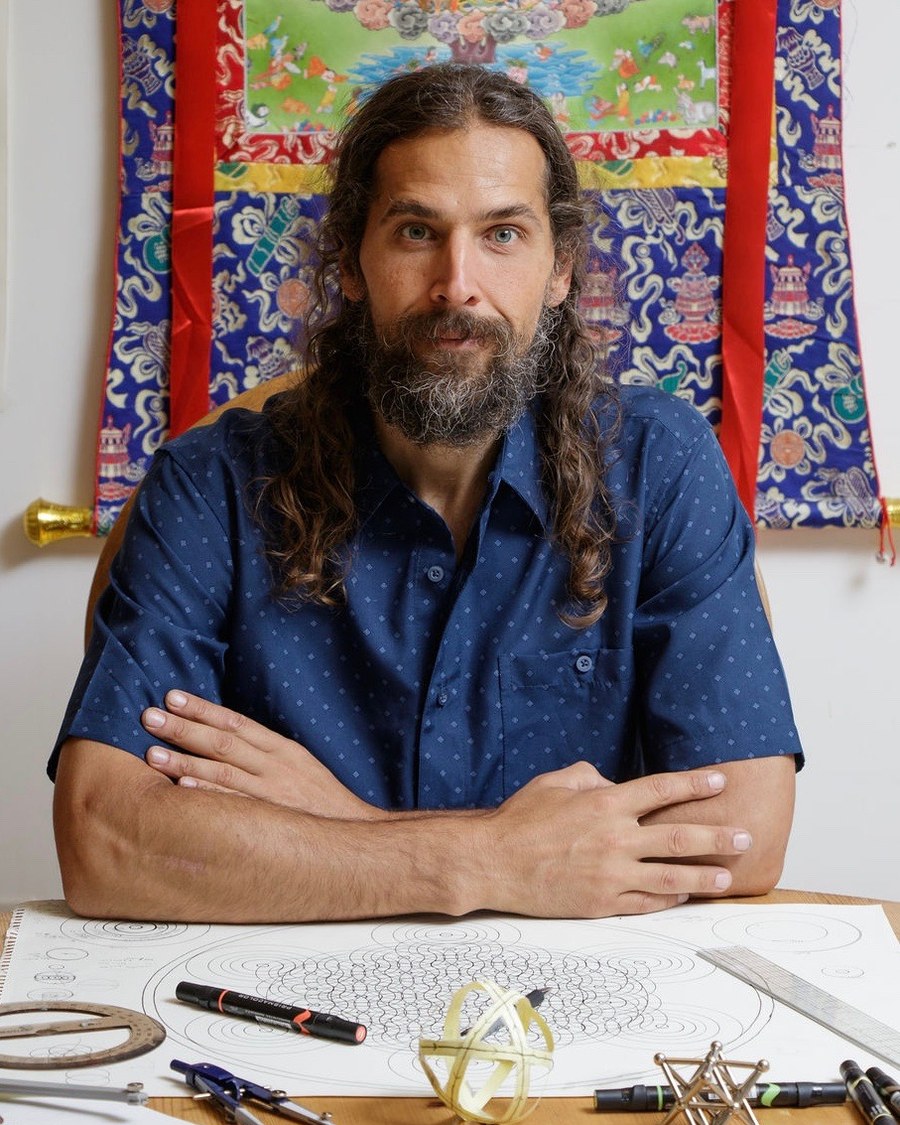

George Leoniak at his drawing table beneath a thangka, a large compass-drawn construction in front of him with dividers, a straightedge and a stellated model

The Geometers

Alongside George, two others shaped the practice — one I have sat across from, and one who settled the question two centuries before I ever picked up a compass.

Robert Edward Grant seated in front of a large reproduction of Leonardo's Vitruvian Man
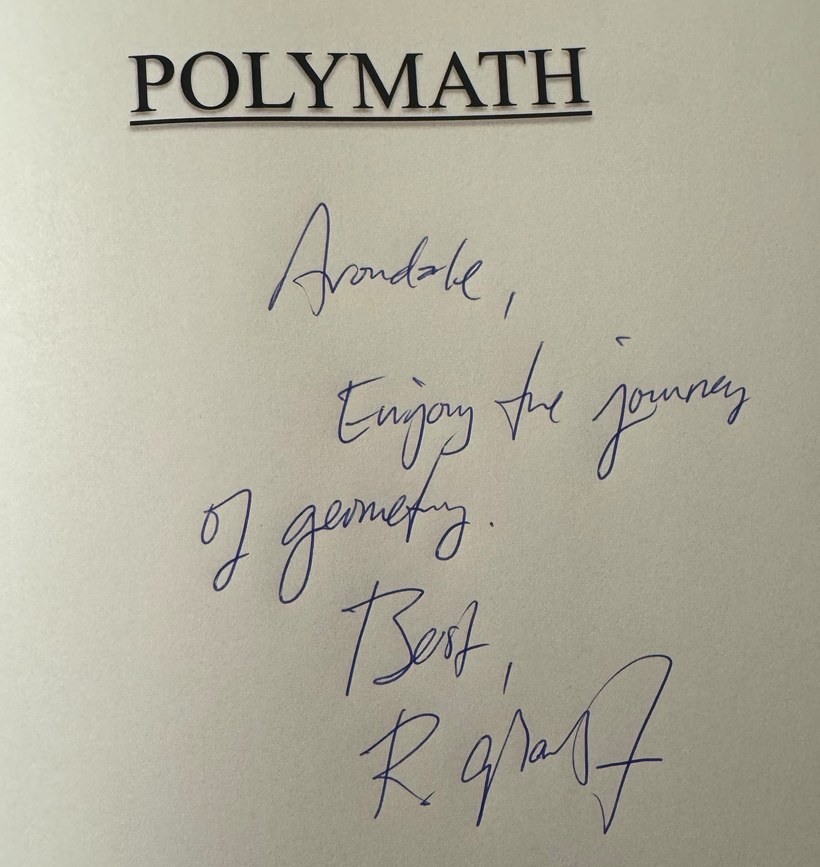
The flyleaf of Polymath, inscribed: Arondale, enjoy the journey of geometry. Best, R. Grant
Robert Edward Grant
Polymath

“Enjoy the journey of geometry.”Inscribed · Polymath

I own his books — one of them signed, there. We first met at CPAK, the Conference on Precession & Ancient Knowledge, in Palm Springs, and have talked one-on-one since, in person and over video, about geometry and the polymathic connections between fields most people keep apart.

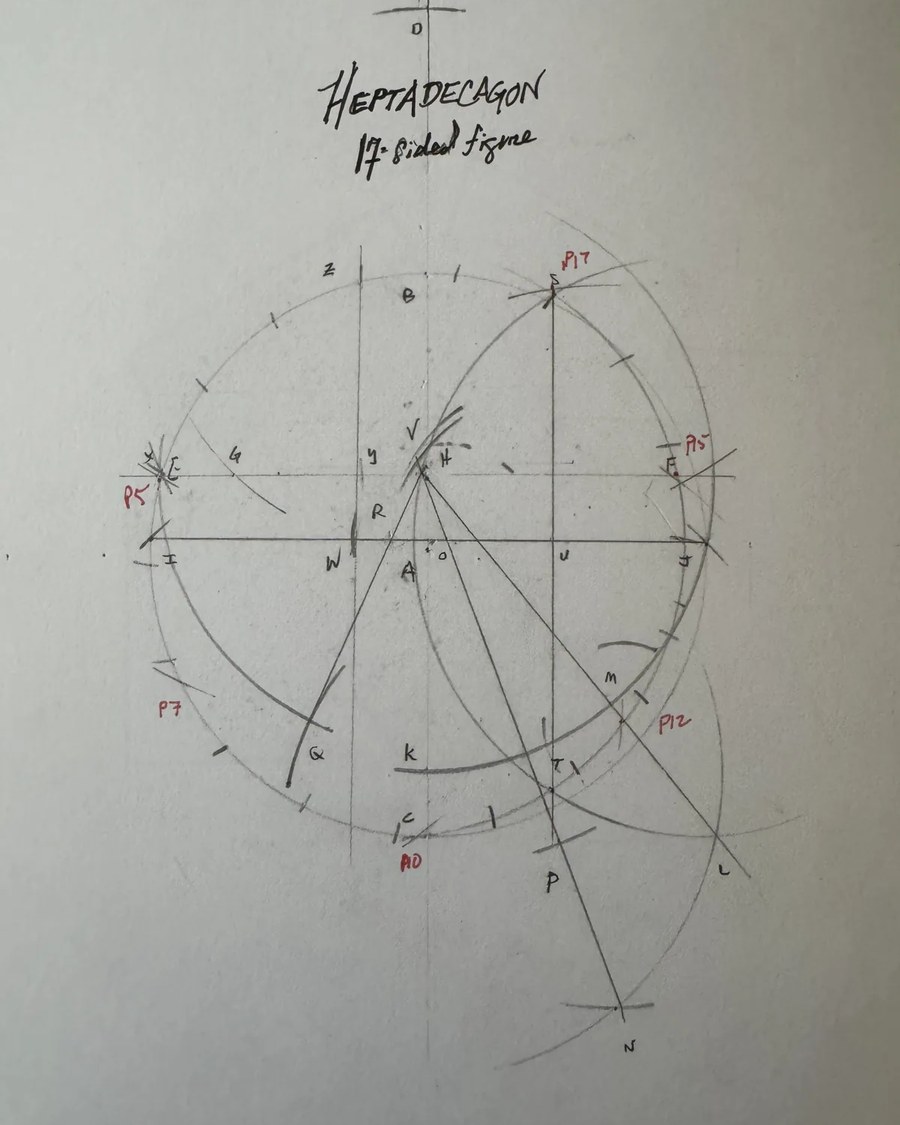
A hand-drawn heptadecagon construction sheet titled Heptadecagon, 17-sided figure, with labelled compass arcs
My heptadecagon, drawn by hand — the figure Gauss proved possible.
Carl Friedrich Gauss
1777 – 1855

On the morning of March 30, 1796, a nineteen-year-old in Braunschweig proved that the regular seventeen-sided polygon could be drawn with compass and straightedge alone. It was not a clever drawing — it was a proof that the drawing must exist, and the first worked construction followed a few years later.

The Mighty Heptadecagon →

The Films

Timelapse constructions — hours of drawing compressed into seconds — and rotation studies of the finished forms.

The Great Rhombicosidodecahedron — twenty hours of drawing, in sixty seconds.
Geometry Journal — Superclip — a timelapse montage across the constructions.
Compound of Five Cubes — in the hand — the finished compound, turned.
Geometry Journal — Stills — plates from the working journals.
Inside the Sketchbook — Great Pyramid studies and moon phases.

Questions about the constructions?

Ask about any figure, or the method behind it.

Ring the doorbell Continue to about →