The Lab
Edition № X · 2026

Mech Warrior, vibe-coded.

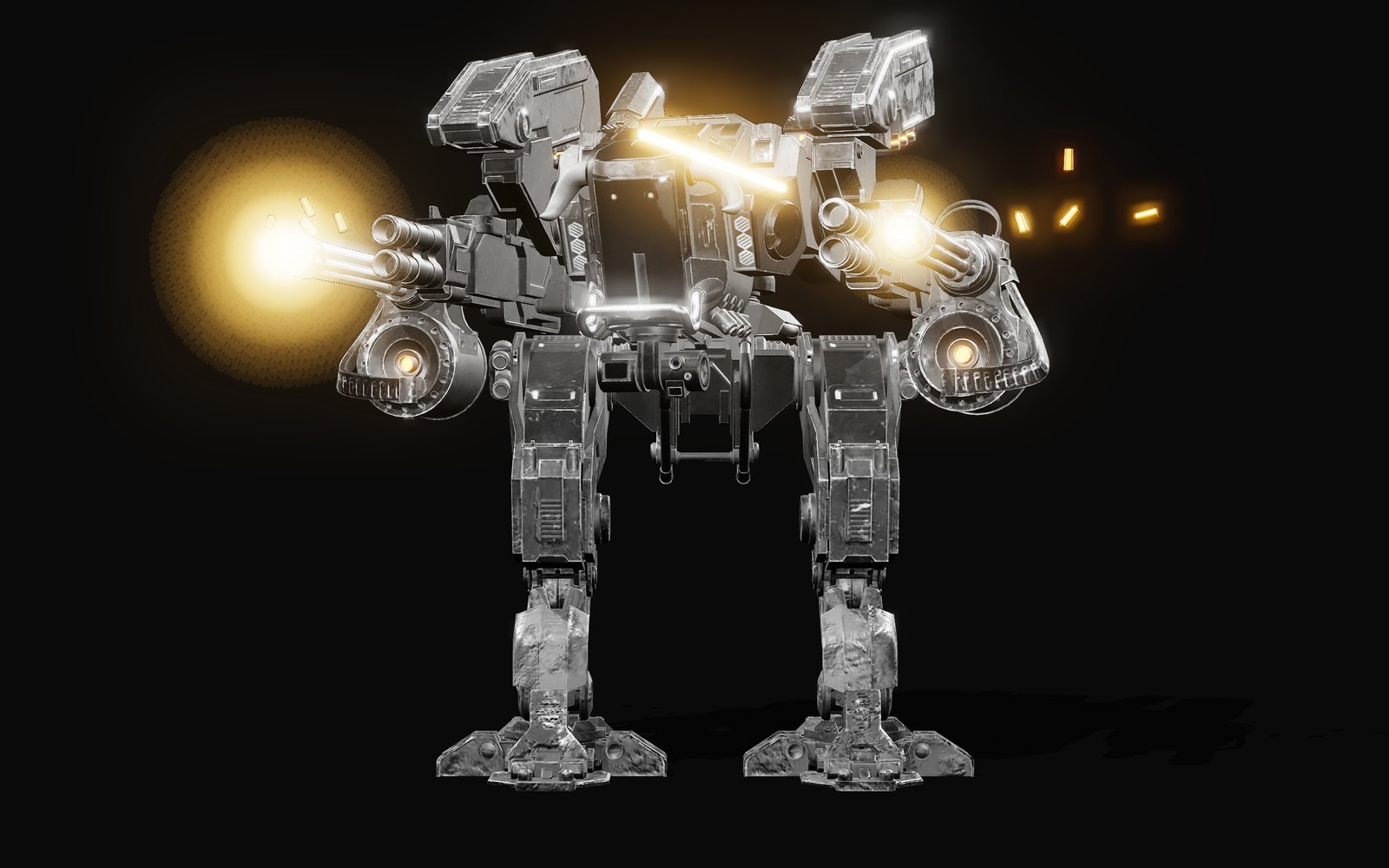
An animated 3D mech that walks onto the page, opens up with a minigun, launches a spiral missile barrage, throws lightning at the glass, and then turns to follow your cursor. An experiment in how far one person prompting AI agents can push a browser: real-time rendering, a model rigged at runtime, and sound built like a film mix.

The mech standing at full height, its minigun raised, steel lit from the left against black
A still. The live version needs WebGL2, motion switched on, and a device with at least 4 GB of memory and four cores.
The running order
  1. It walks in from the right

    A procedural gait on a two-bone leg rig, cut at runtime out of a model that shipped with no skeleton at all. It settles on the left of the stage.

  2. The minigun

    Tracer rounds, brass ejecting and bouncing, the muzzle flash lighting the steel around it.

  3. The missile barrage

    Each missile flies an Archimedean spiral, launched at Fibonacci intervals and turned by the golden angle from the last. One goes rogue.

  4. The storm

    A slow charge that throbs like a rotor, then three bolts thrown straight at you, 40 degrees apart. The glass cracks where each one lands, then heals.

  5. It tracks you

    From then on the machine follows your pointer. Click it to fire again; on a phone, tap.

How it was made

Method

By prompting, not by hand. One long conversation with AI agents, from the first rough render to the thunder: I set the direction, judged each frame and each sound, and sent it back. About nine hundred lines of JavaScript came out the other end.

No video, no sprite sheet. The mech is a free 3D model drawn live with three.js onto a transparent canvas, so it stands directly on the page. It is cut in half down the centerline, hung on a bone rig built at load time, and walked by code.

Sound is half the effect. The lightning charge, the thunder and the glass are synthesized in the browser. The guns and missiles are trimmed public-domain recordings. All of it runs through a convolution reverb and a compressor so it sits in one room. Browsers allow sound only after a first click, so the mech waits for one before it deploys.

← Back to the Lab